Natia works deftly with flour-covered hands, the crackle of logs popping in the ancient stone oven behind her (Fig. 1). She stretches and works the dough thinner until she can nearly see through it. In quick succession she grabs a small pot and begins to ladle ghee onto the surface, followed by folding and more ghee. She repeats this process until she has a small square, which she stuffs with homemade white cheese. She has made what is known in the area as a kada, a Meskhetian version of the more famous Georgian cheese bread, khachapuri. Natia’s family recipes are at the center of a relatively recent change in rural villages in Samtskhe-Javakheti, the southwestern region of the Republic of Georgia. This change involves communities tapping into and revitalizing lost or dying traditions with the rising tide of cultural tourism in the South Caucasus.
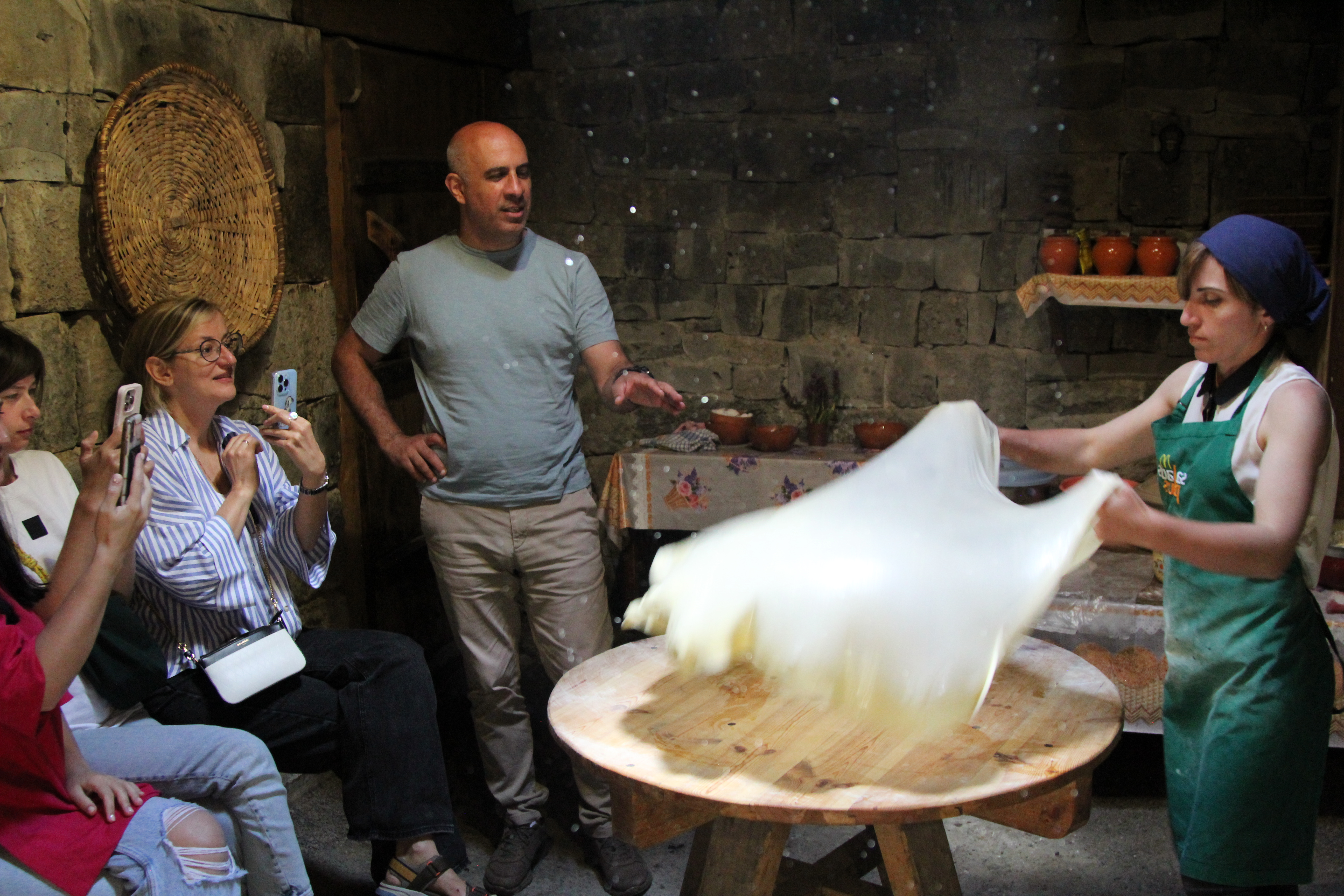
I spent time working with the Georgian–Australian Investigations in Archaeology expedition as the team’s ethnographer, trying to under-stand how locals interact with archaeological sites and materials around them. I observed how residents are turning to their historic semi-sub-terranean homes and the traditions associated with them as a part of their connection to their past. While these homes have several notable features, locals are most concerned about one element in particular, the stone oven, or purnia. The oven is set into one of the walls of the home’s darbazi, or main hall. It has a large opening for bread and baked goods and a smaller opening to the right where people light and keep the fire while cooking. Natia boasts to tourists who visit that she cooks her kada in a 300-year-old oven, built by her ancestors. Indeed, the blackened and weathered stones speak of their age.
Residents in Chobreti and many other villages in the Samtskhe-Javakheti region have lived in their traditional semi-subterranean homes since the seventeenth century (Fig. 2). It was only in the 1960s, when Soviet authorities constructed new homes, that most people abandoned their old abodes in favor of the new. A large painting in Natia’s restored home depicts her village in the late nineteenth century with semi-subterranean homes around the freestanding church, the only fully aboveground structure. Small objects like pots, pans, and even old leather shoes decorate her restored home, giving the space an air of authenticity. Members of the community have donated many of these items as tourists have flocked to Natia’s home for a traditional experience. Seeing the success of the home in Chobareti, others are beginning to look at their traditional spaces and possessions in a new light.
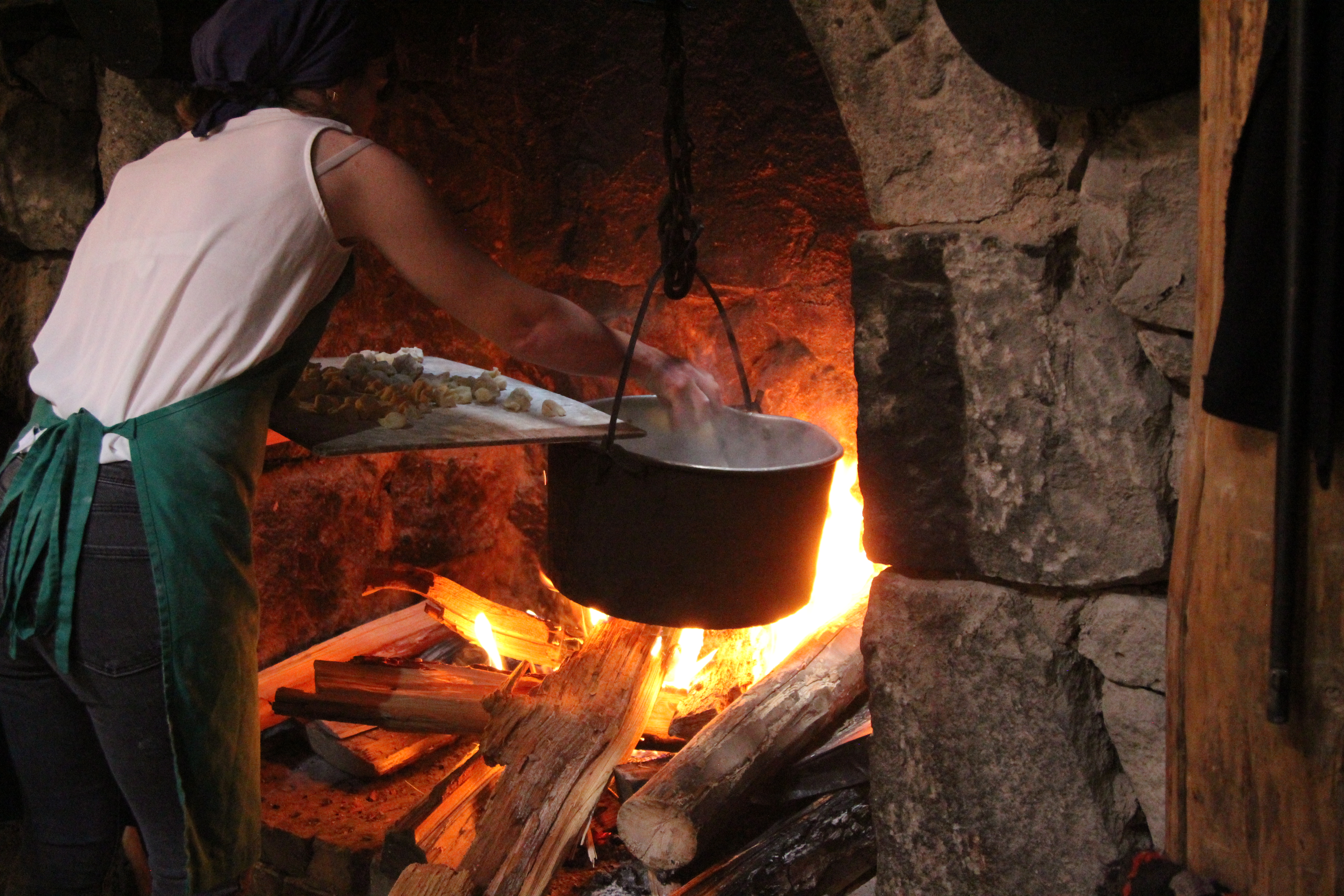
Georgians are attempting to rediscover lost traditions and culture in the wake of the Soviet Union and with the rise of cultural tourism. Dalila Tsatava, the director of the Gastronomical Association of Georgia, has been leading the way in this effort, publishing books and working with remote villages all over Georgia with an aim to rediscover Georgia’s lost culinary heritage. Her work has taken her to Samtskhe-Javakheti; her most recent book includes several local recipes that Natia serves at her home in Chobareti, such as goose dumplings (Tsatava, Dalila. 2023. Gastronomic Dreams. Tbilisi: Intelekti.:46). On October 23, 2025, the National Agency for Cultural Heritage Preservation Georgia announced in a social media post that the construction techniques and knowledge of these homes had been granted immaterial cultural heritage status (National Agency for Cultural Heritage Preservation Georgia. 2025. The Building Traditions of the Meskhetian Erdo-Gvirgviniani (Crowned Zenith Window) Hall-Type Dwelling Have Been Granted the Status of an Intangible Cultural Heritage Monument! https://www.facebook.com/georgianheritage.). Locals in Chobareti and neighboring villages have begun to look toward government grants and institutions that might be able to help them preserve their homes and traditional ways of life.
Bibliography
- National Agency for Cultural Heritage Preservation Georgia 2025
- National Agency for Cultural Heritage Preservation Georgia. 2025. The Building Traditions of the Meskhetian Erdo-Gvirgviniani (Crowned Zenith Window) Hall-Type Dwelling Have Been Granted the Status of an Intangible Cultural Heritage Monument! https://www.facebook.com/georgianheritage.
- Tsatava 2023
- Tsatava, Dalila. 2023. Gastronomic Dreams. Tbilisi: Intelekti.