The Rock Art Archive welcomes Catharina E. Santasilia to her new role as archive manager. Cat received her doctorate in anthropology at UC Riverside in 2019. She brings her expertise in archaeology through fieldwork in Belize and Mexico, and in archival and database management during the past two years with Jo Anne Van Tilburg’s Easter Island Statue Project (EISP). Realizing that more hands were needed if the archive was to meet its stewardship and planned publication goals, we turned to our longtime colleague Brandon Lewis, a UCLA alumnus who today is a professor of archeology at Santa Monica College. Brandon’s students have worked closely and often with the archive and the EISP team and have collaborated with other researchers on countless Cotsen projects. Coincidentally, Lewis was looking for new projects for his students to earn credits toward an archaeological certificate.
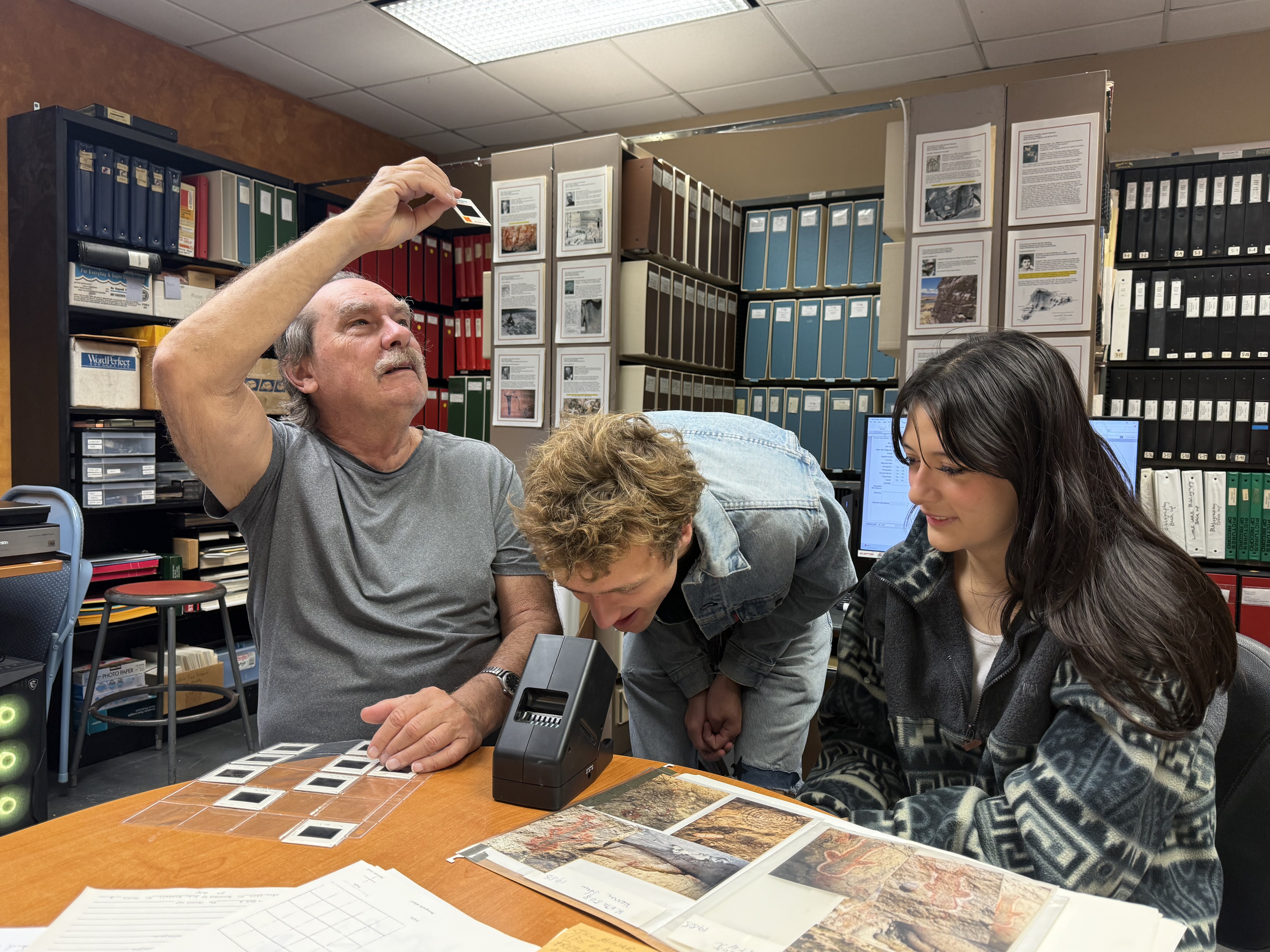
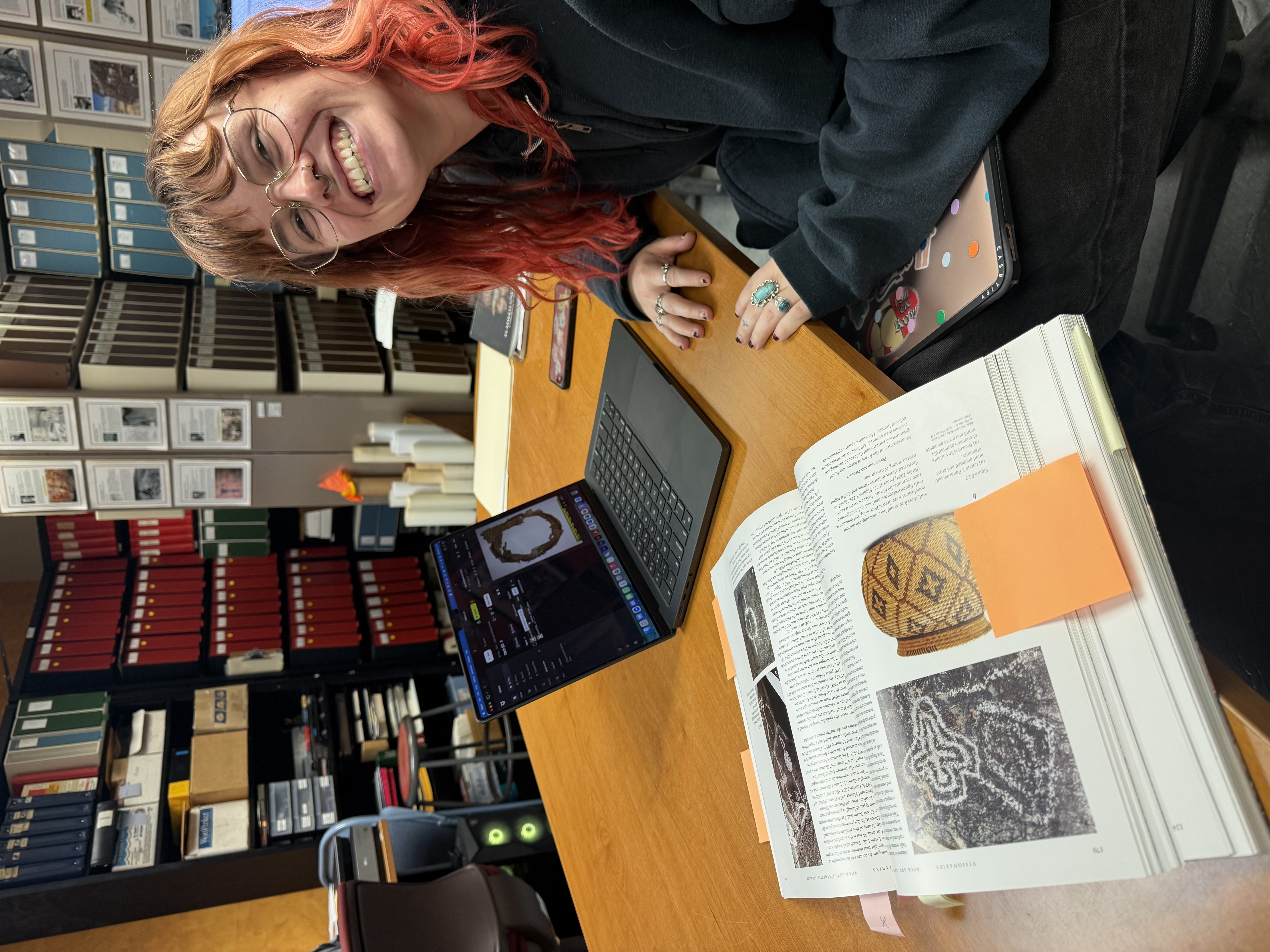
Earlier in the year, the archive upgraded its technological capacity with new computers and the assistance of Jason Liang and the Cotsen staff. The upgrades were put to the test when four enthusiastic students arrived during the first week of June. They spent several hours exploring rock art site records and learning the ins and outs of the archive’s database. Two weeks later they joined an archaeological excavation team in Belize with Lewis, who sent a new group of students our way. They reconnected with the archive and continued volunteering long after completing their certificates (figs. 1a and 1b). One student has already transferred to UCLA, and we hope more will follow next year. The involvement of UCLA and Santa Monica College students in the archive is a valuable stepping stone for each of them, no matter what profession or ongoing education they ultimately choose. Many of the nearly 30 past UCLA work study students who worked closely with former volunteer Gordon Hull gained needed skills across many areas by interacting with the archive’s diverse and supportive volunteer staff.
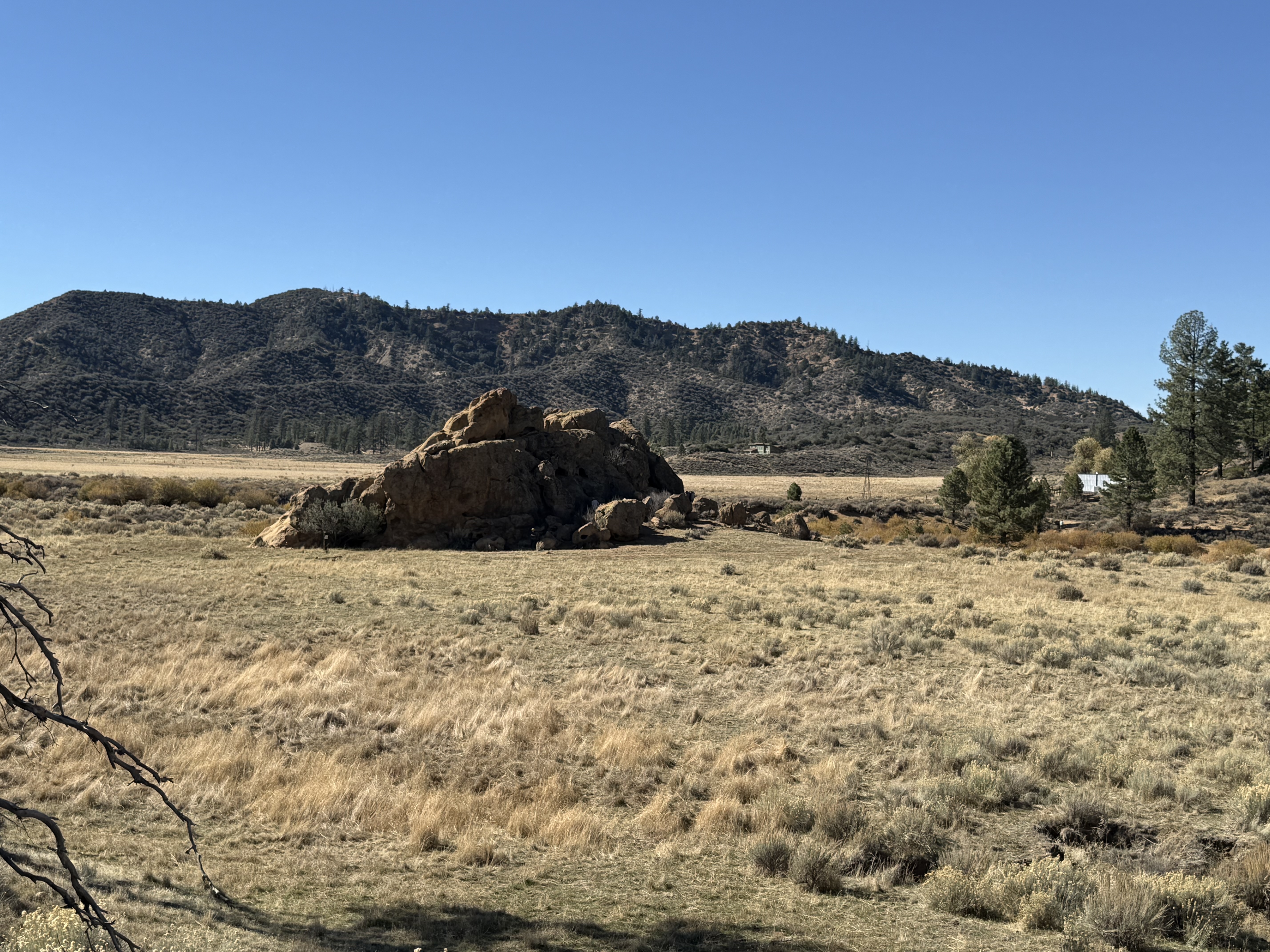
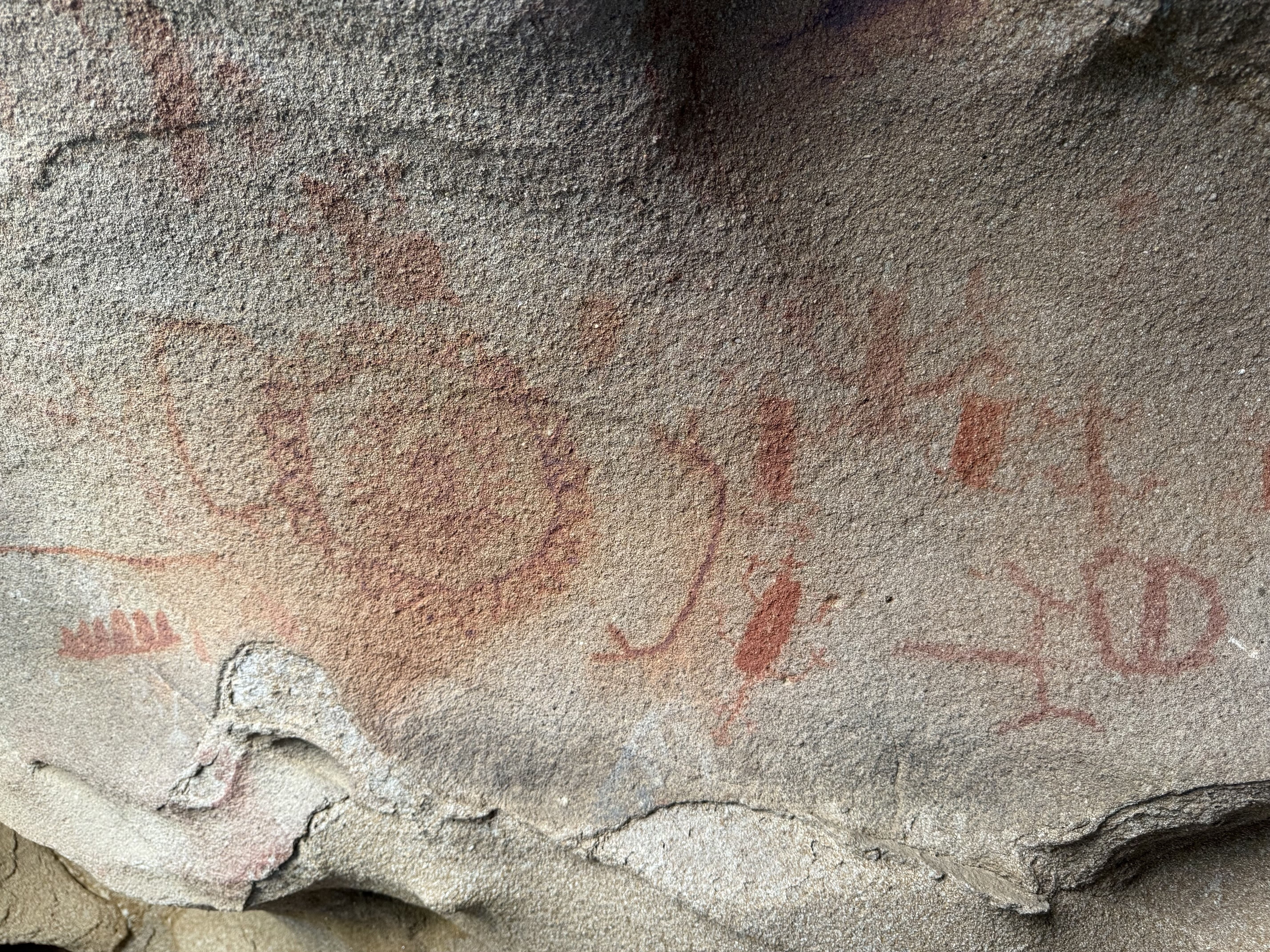
In September, a visitor stopped by the archive, hoping to use our resources to learn more about the rock art on her property. We located several items, and she invited us to visit her family ranch in Ventura County. The students shifted their focus in the site record entry process to learn more about that region’s rich rock art tradition. On Sunday, November 2, 12 of us departed Santa Monica early in the morning and headed 90 miles north of Los Angeles. At our meeting point, we connected with another California archaeology group, making the trip even more educational. After a 40-minute journey, crossing several (luckily mostly dry) creeks in our four-wheel-drive vehicles, we arrived at our destination (figs. 2a and 2b). Everyone recognized how privileged we were to visit this sacred place, and because it is located on private land, the site is well protected while still available for educational visits.
The protocols for observing and recording rock art on private land are the same as those for public land.1 Respect for Indigenous cultures is inherent and acknowledged. Since most painted rock art is in confined spaces, such as small concavities on a cliffside or on the ceiling or walls of caves, only a few people at a time can view it. For many student vol-unteers, this was their first experience with rock art, and they were all genuinely enthralled. We are already contemplating future outings and considering how we can best make these visits productive while collect-ing data for the archive. Members of the Cotsen community are cordially invited to join us on any of our Rock Art Archive field trips.
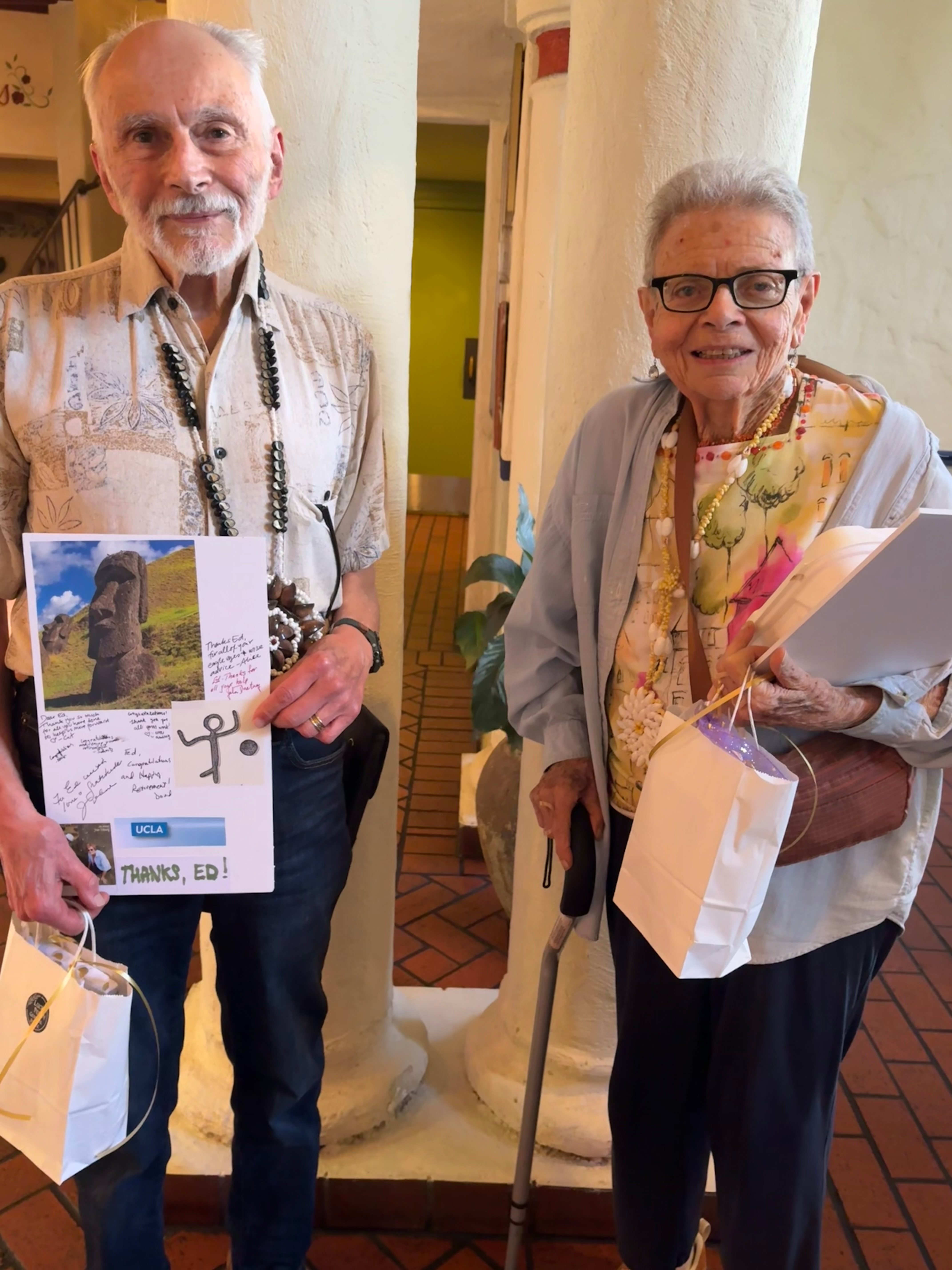
This year we bid farewell to longtime volunteers Audrey Kopp and Ed Schoch, who both chose to retire after more than 25 years of dedicating their time, effort, and substantial expertise to the archive. Their enthusiasm and skills sustained the archive even as the pandemic wound down and until the archive opened again. Their many contributions include involvement in Little Lake fieldwork and publications, maintain-ing and managing the bibliography database, and, not least, responding to public rock art inquiries. We are deeply grateful for everything Audrey and Ed have done over the years, and their legacy endures.
To express our sincere gratitude to them, we gathered our colleagues from the archive and EISP to toast their retirement (fig. 3). This allowed the retirees to meet some of their successors, who in turn had the opportunity to celebrate Audrey and Ed’s accomplishments. The event was held in Santa Monica at a legendary Mexican restaurant we often frequent for celebrations. Audrey and Ed both contributed their skills to the preparation of Van Tilburg’s Te Moai Rapa Nui: Easter Island’s Megalithic Statues. The volume is designed as an illustrated archaeological atlas, and it includes approximately 150 maps by cartographer Alice Hom, herself a former archive staff member.
Longtime volunteer Ron Tallerkson, among the first to discover an intact brownware pot during our fieldwork at Little Lake—one of only about 50 known in California—continues to contribute his cheerful, tire-less efforts to updating the rock art library and bibliography. John Bretney, coeditor of Rock Art at Little Lake: An Ancient Crossroads in the California Desert (Cotsen Institute of Archaeology Press, 2012) continues his dedi-cation to Native cultural recognition through volunteerism at the archive. John’s wealth of knowledge about the California desert and its rock art sites enriches the student experience immensely.
Little Lake is an ongoing presence in the work of the Rock Art Archive, and connections to it were again revived when retired archaeologist C. J. (Jill) Minar contacted Van Tilburg to share a personal quest. In 1984, Dr. Adella (Dee) Schroth (1939–2018) was one of the first California archaeol-ogists to embrace the newly emerging magic of computerized data filing. She employed the new technology in her analysis of large shell middens (Ca-Ora-388). In her professional career, Dee conducted CRM projects throughout California and published or posted countless reports of her fieldwork (44 entries on tDAR).
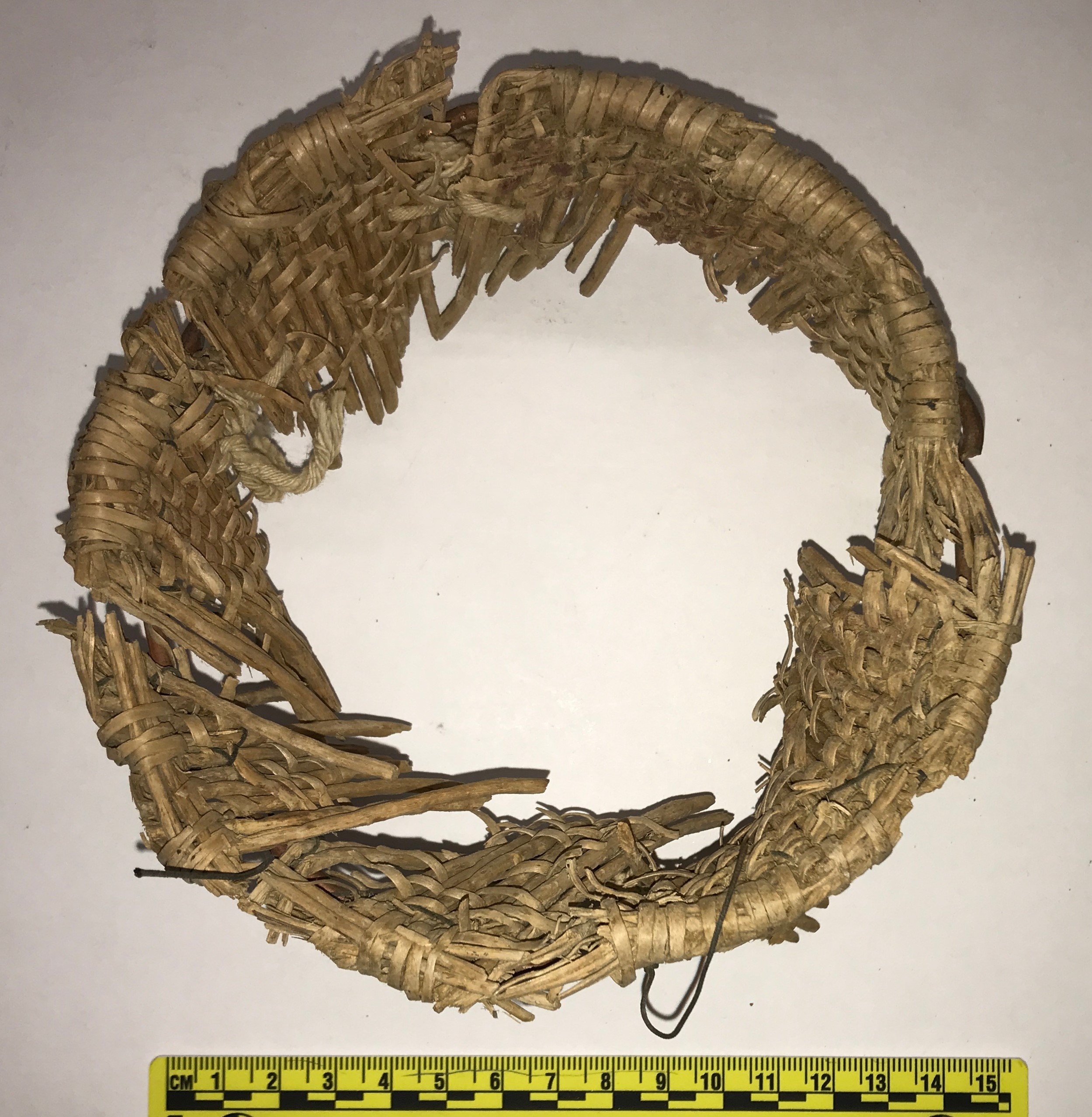
As a graduate student at UC Riverside, Jill had consulted on Dee’s dis-sertation fieldwork at Little Lake and in Pinto Basin, Joshua Tree National Park. Because Jill was interested in basketry, Dee had loaned her a collection of basketry purportedly from Little Lake caves. The collection consisted of woven fragments and some wooden items. According to Dee, it was “not spectacular to look at but very valuable in terms of bas-ketry analysis.” Dee’s goal was for Jill to analyze the collection and write it up for her proposed volume on Little Lake archaeology. At the time, Jill was just beginning her graduate program and Dee was nearly finished. Their professional lines and research interests diverged, and neither the proposed basketry project nor the book came to fruition.
The Little Lake basketry collection stayed in Jill’s possession, and she had always hoped to return it to Dee. In the meantime, Jill took appropriate steps to protect it. She asked Fresno photographer Diana Baldrica to photograph the collection and to rehouse each fragment in archival-quality materials (fig. 4). However, she didn’t know to whom the collection actually belonged. After Dee’s death, Jill remembered that in about 1992, Dee had said something about a fire and that the Little Lake records may have been lost. Jill guessed that the collection might have come from the San Bernardino County Museum, where Dee had worked. In 2018, Jill spoke with Tamara Serrano-Leiva, the curator there, but there was no record of Little Lake basketry, so she reached out to Van Tilburg.
Basketry is a craft of great interest in the area around Lone Pine, where many Native families live and work. Women from the area sometimes went down to Little Lake to collect other types of basketry materials. There was a lot to learn from them, but it didn’t include information about Dee’s basketry collection. In the meantime, Jill was “deep in the weeds” teaching at Fresno City College. The Little Lake basketry collection again went to the bottom of her to-do list.
After retirement, Jill heard from Tamara Serrano-Leiva again, and in 2025 Jill connected with curators Karimah Richardson and Sarah Signorovitch at the Autry Museum of the American West. The Autry curates Little Lake lithics collections made by archaeologist Mark Harrington. Members of the archive team had reviewed those collections at their original repository, as well as others from Little Lake that were widely dispersed, including at Arizona State University. (That’s a story for another day.) Discussions with the Autry ensued, and photos were sent; the Autry accepted the Little Lake basketry collection, which was personally delivered by Jill and Monica Bellas, another UC Riverside anthropologist.
Basketry, however fragmented, was often decorated with motifs not unlike many seen in California desert rock art. It and the pottery we found are distinctive markers of “women’s work” within the larger context of social gatherings and spiritual observances at Little Lake. All the women involved in this saga sought a permanent curatorial home for these priceless basketry fragments through a sense
of duty to legacy data. Beyond that, however, was a collective respect for the people—probably also mostly women—who had crafted the bas-kets. Recognizing how close she came to a less-than-happy ending for the Little Lake basketry collection, Jill cautions us all: “I encourage other archaeologists and senior scholars to consider the futures of collections in their care. It may be time to begin making plans before it is too late.”
That admonition is generally taken to heart by rock art enthusiasts, nearly all of whom are volunteers and aficionados. It was also understood by the late Clement W. Meighan, a UCLA Department of Anthropology faculty member and founder in 1979 of the Rock Art Archive. His goal was to provide a home for orphaned data, and collectively we have accomplished that. The specific objectives ahead are multifaceted, with the main focus on continued updating and digitization of the many resources housed in the archive. One aim is to summarize our collections in a planned volume and on an interactive map of trends in design and aesthetics. Multiple tasks lie ahead, and new learning opportunities will no doubt emerge during our stewardship of this valuable archive.
Notes
-
See www.rockartnetwork.org. ↩︎