If you are a graduate student in the UCLA/Getty Conservation Program, you either know William Shelley or benefit from his work as program laboratory manager. Being a professional conservator and himself a 2016 graduate of the master’s program, Shelley is uniquely qualified to make sure the laboratories necessary for graduate students’ use are consistently supplied and technologically up to date. As Glenn Wharton, chair of the program, puts it, “We were incredibly fortunate to hire William. Having gone through our program himself, he understands the student experience. This makes him highly effective in helping make our courses and the functioning of our research lab work well for both students and faculty.”
Working with both professors and students, he ensures there are sufficient supplies for academic requirements as well as for all the treatments involved. As an example, he says he often creates mockups on which students can practice conservation techniques so that “their first experience is not on an actual object” being studied. He also assists with and has been trained to do X-radiography. He has developed a close relationship with the antiquities conservation department at the Getty, where he was an assistant conservator before coming to UCLA.
Shelley describes himself as the “registrar” for the Conservation Program, keeping track of objects that come in from local institutions or museums, which must eventually be returned. “Somebody has to be responsible for arranging those loans and the paperwork required for each object,” he notes. It can be intimidating, he adds, “especially when you have very small objects, to make sure that nothing unexpected happens.” He continues, “We also have a small study collection of our own objects, so the students and professors can use those objects without having to worry about asking permission from the lender. This is especially important when we want to practice taking a sample, test a new treatment, or use certain chemicals. With our own objects, students can go ahead and use those before they work on others.”
When objects are originally submitted for examination, “the initial agreement is that the objects will be housed at the Getty Villa,” Shelley explains. “Then our students will examine them and prepare treatment proposals.” Proposal usually include all the steps students would like to carry out, such as cleaning, repair, or a full-scale reconstruction. Shelley can help by reviewing a proposal, which will then be sent to the lender, who must sign off before the students can start work. He gave an example of a ceramic pot that had been put together elsewhere. The pieces were poorly adhered and were failing. So the students took the vessel apart and put the pieces together more professionally.
“Our lab is a little unique in that it is an off-campus lab, located within the Getty Conservation Institute (GCI) at the Getty Villa in Malibu,” Shelley notes. His duties include making sure that members of the Conservation Program “follow all of the health and safety requirements” of the Getty, as well as those of UCLA. The Conservation Program also has a lab housed at the Cotsen Institute; it is primarily an analytical lab. Students using the program’s labs include MA and PhD candidates.
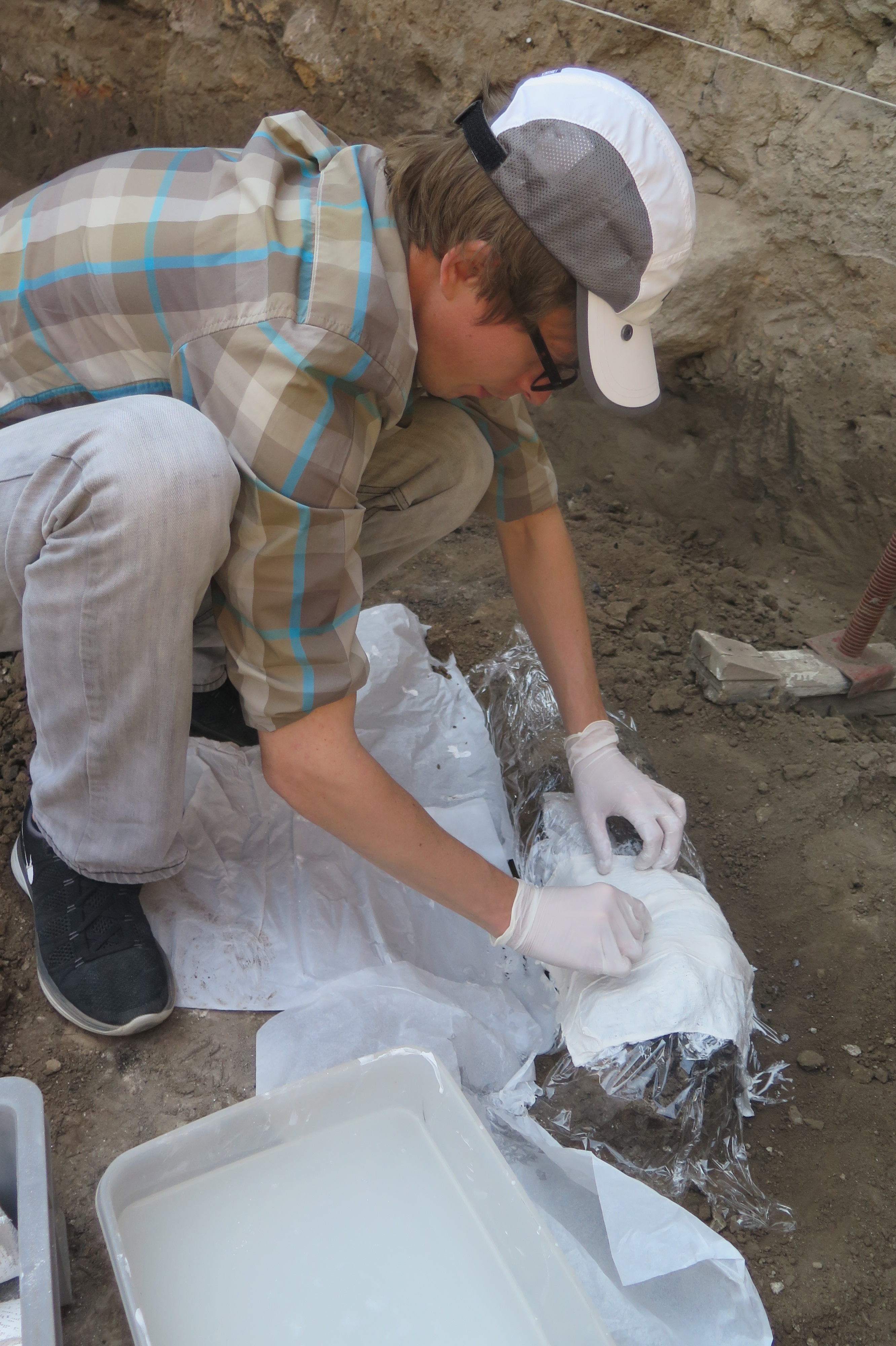
Shelley received his BA in art history from the University of Miami, Florida, and a post-baccalaureate certificate in conservation from the Studio Arts Center International in Florence, Italy. He completed his third-year graduate practicum internship in Kalamata, Greece, working at both the Laboratory of Archaeometry at the University of Peloponnese and at the thirty-eighth Ephorate of Prehistoric and Classical Antiquities. He also completed internships at the Toledo Museum of Art, the Maryland Archaeological Conservation Laboratory, the Anthropology Conservation Laboratory at the National Museum of Natural History, and the Western Archaeological and Conservation Center.
When looking for graduate programs, he wanted a school that offered fieldwork and education in three-dimensional objects. UCLA offered both, plus the opportunity to go abroad to work on excavations. As for the future of the program in which he is so deeply involved, he is working with program chair Glenn Wharton on incorporating sustainability “not only into our program but into our lab.” He sees one of his main responsibilities as greening the lab and making it more sustainable, as well as helping faculty with “practicals” within their syllabi.
In terms of the lab, this effort might include determining how to better recycle materials such as gloves and to reuse them whenever possible. “That’s one physical thing we can do,” he notes. Another is to use chemicals that are less harmful to the environment, both when they are produced and when they are used: “So the disposal is one thing, but creation is another.” He adds that Wharton has brought in a visiting researcher from Italy whose primary work will be on green chemicals in the field of conservation.
Shelley is the coauthor of “Preliminary Research into Curricula in Sustainability for Cultural Heritage Conservation,” published by the American Institute for Conservation. He also authored “The Modern History of the Twin Obelisks of Benevento,” published in Aegyptiaca: Journal of the History of Reception of Ancient Egypt. This paper documents the work he did on conservation at the Getty Villa and on display of an Egyptian obelisk in Italy.
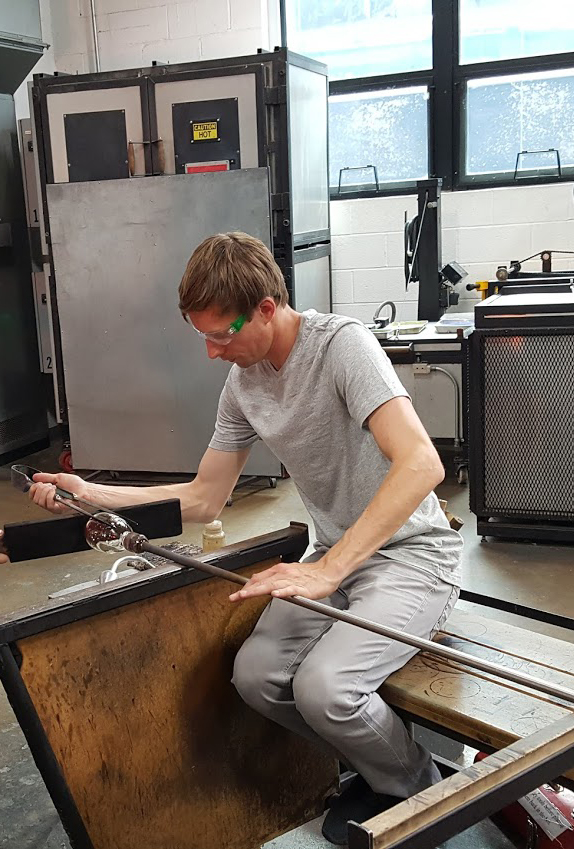
He has little free time between work and his family—currently including a four-year-old daughter and a three-year-old son. If he did have more time, he might return to making glass in local studios. Another favorite activity is visiting local botanical gardens, which he can do with the entire family, no matter what size it is.